How to make matcha step by step — ratios, temperature and the usual mistakes
Good matcha is not bitter. If yours is, the culprit is almost always the water, the ratio or the clumps rather than the tea. Below is a concrete guide: how much, in what, at what temperature, and what to do when you have no bamboo whisk.
Matcha is the only tea you consume entirely — you do not steep a leaf and throw it away, you suspend the powdered leaf in water and drink it along with it. That is why the rules for preparing it differ from every other tea, and why it is so easy to ruin.
What you need
- Ceremonial matcha — 2 g per serving (a heaped teaspoon, or 1.5–2 scoops of a bamboo chashaku).
- Water at 70–80°C — not boiling. Without a thermometer kettle: boil it and leave it to stand for 3–4 minutes.
- A sieve — the most important and most often skipped item. Matcha compacts into clumps that no whisk will break.
- A chasen (bamboo whisk), or an electric frother, or a screw-top jar.
- A bowl — a wide bowl (chawan) leaves room for the whisk to move; a coffee mug is too narrow.
Ratios — one table instead of guesswork
| Version | Powder | Liquid | Result |
|---|---|---|---|
| Usucha (everyday) | 2 g | 60–70 ml water | light, foamy |
| Stronger usucha | 2.5 g | 60 ml water | denser, more pronounced |
| Koicha (ceremonial) | 4 g | 30 ml water | thick, no foam |
| Latte | 2 g | 40 ml water + 150–200 ml milk | creamy |
| Iced | 2 g | 200 ml cold water + ice | sweeter, refreshing |
Measure by weight or with a scoop. Guessing almost always means twice too much — the most common cause of a bitter bowl after water that is too hot.
Water temperature — why 70–80°C specifically
The tea leaf holds two groups of compounds with opposite tastes. Amino acids (mainly L-theanine) give sweetness and umami. Catechins and tannins give bitterness and astringency. The latter are released more readily the hotter the water.
| Temperature | What you get |
|---|---|
| Below 60°C | sweet but flat; weak foam, powder disperses poorly |
| 70–80°C | balance — umami with a light bitterness behind it |
| 85–90°C | bitterness starts to dominate |
| Boiling | pure astringency, umami gone |
A practical tip without a thermometer: boil the water, pour it into a second vessel and let it stand for 3–4 minutes. Each pour drops the temperature by roughly 5–10°C.
The water matters more than you would think
This is skipped in almost every guide, yet it can ruin good matcha more thoroughly than a few degrees too many. Hard water flattens the flavour — calcium and magnesium bind the compounds responsible for umami, and the drink comes out dull, with a chalkier bitterness and weaker foam.
- Best: filtered water, or bottled water low in minerals (below roughly 100 mg/l dry residue).
- Acceptable: tap water in a soft-water area.
- Problematic: hard tap water and highly mineralised waters.
- Bad: distilled water — with no minerals at all the flavour falls apart too and turns hollow.
If your matcha tastes of nothing much despite correct temperature and ratio, make one bowl with bottled water before you change tea. The difference can be startling.
Usucha — thin matcha (the everyday version)
This is the one people drink daily: light, foamy, with pronounced umami. Before you start, warm the bowl and the chasen — pour in boiling water, tip it out, wipe dry. Cold ceramic chills the drink, and dry bamboo is brittle and snaps more easily.
- Sift 2 g of matcha through a fine sieve straight into the bowl. That single move eliminates 90% of clumps.
- Prepare water at 70–80°C — boil it and let it cool.
- Add a splash of water (a spoonful, no more) and work the powder into a smooth paste. This is the single most important step in the whole guide.
- Top up with the rest of the water to about 60–70 ml.
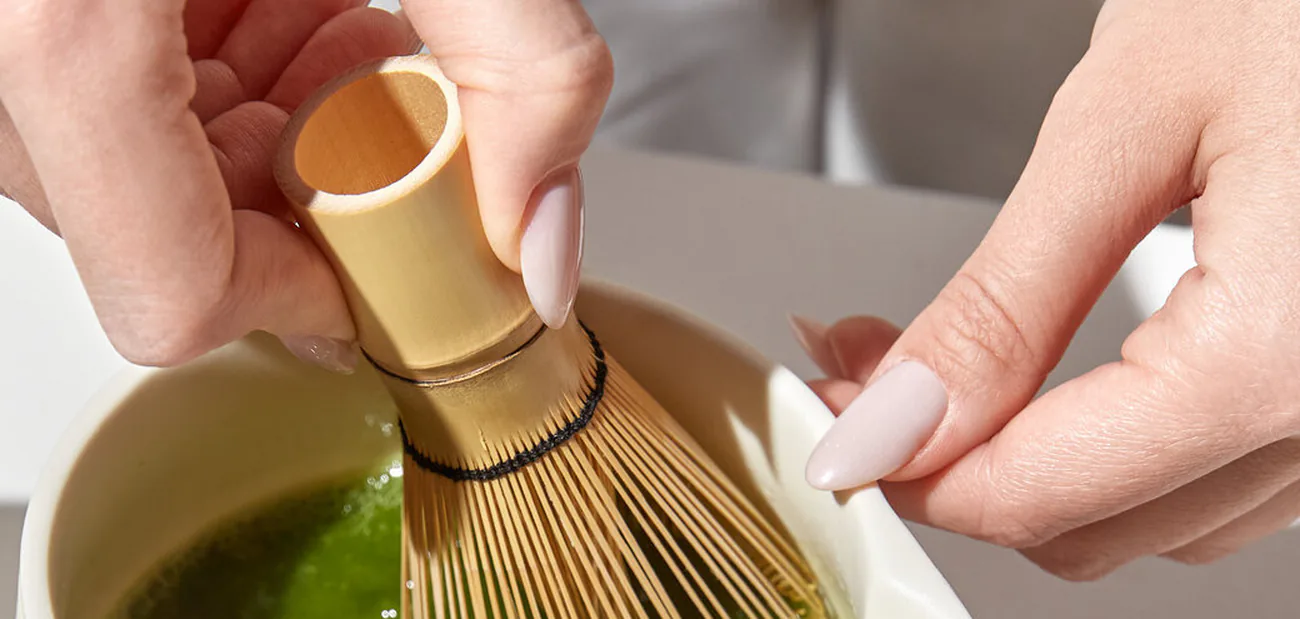
- Whisk for 15–20 seconds in a W or M motion, just under the surface, from the wrist rather than the whole arm. No stirring in circles — the point is aeration, not a vortex. Finish with a spiral from the rim to the centre and lift the whisk out.
A dense, fine foam with no large bubbles should remain on top. Drink it straight away. After a few minutes matcha settles to the bottom and loses its creaminess — that is normal, not a fault of the tea.
Why paste before water
Because matcha particles are a few micrometres across and, on meeting a large volume of water, they coat themselves with it on the outside, forming beads that stay dry inside. Such a clump will never disperse — you could whisk for a minute and it would still be there. A spoonful of water and a rub against the bottom of the bowl solves the problem before it exists.
The same rule applies with any tool, including a frother and a shaker: matcha without a whisk →
Koicha — thick matcha
The ceremonial version: 4 g of matcha to 30 ml of water. It is not whisked into foam but worked slowly with the whisk to the consistency of runny honey — a slow, almost kneading motion, with no aeration.
Koicha is merciless about quality — culinary tea will produce a bitter paste. It only makes sense with first-harvest ceremonial grade. It is also the best test of a powder that exists: if the koicha is drinkable and faintly sweet, the matcha is good.
A matcha latte that is not just sweet milk
The most common mistake at home and in cafés: tipping the powder straight into milk. Matcha will not disperse in it and clumps will remain.
- Make usucha with 40 ml of water (a stronger concentrate).
- Add 150–200 ml of milk heated to 60–65°C — any hotter and the milk turns bland and kills the umami.
- Sweeten only at the end, and only if you really must. Good matcha has a sweetness of its own.
Among plant milks, barista oat works best — its fat carries umami rather than muffling it as some almond milks do. The full recipe and variations: matcha latte recipe →
No chasen? Three substitutes that work
- A screw-top jar: matcha, water, close and shake for 20 seconds. Surprisingly good foam.
- An electric frother: fast and effective, though the foam is coarser and less durable.
- A kitchen whisk: it works, but only after sifting — it will not break clumps.
What not to use: a jug blender for the hot version (it aerates too aggressively and heats the drink) and a spoon (no chance).
Five mistakes that make matcha bitter
- Boiling water. Above 85°C you scorch the L-theanine and amino acids behind the sweetness, leaving only tannins. This is mistake number one.
- Too much powder. Two grams means two grams. Guessing usually means 4 g and an undrinkable bowl.
- Not sifting. A clump of matcha is concentrated bitterness in a single mouthful.
- Culinary grade drunk plain. Later harvest, older leaves — here bitterness is built into the raw material, not the technique.
- Old matcha. Once the tin is open you have 4–6 weeks. After that the green greys and the flavour turns hay-like. Store it airtight, in the fridge, away from light and smells.
We gathered the full list of causes of bitterness, including those on the raw-material side, here: why matcha tastes bitter →
Afterwards: rinse the chasen immediately
The whisk is the most failure-prone item in the set, and it almost always dies for one reason — it is left with matcha residue until the evening washing-up. Rinse it in warm water alone, with no detergent, right after use and stand it tines upwards on a holder or on the rim of the bowl so it dries.
Never in the dishwasher and never left submerged — bamboo soaks up water, swells, and the tines snap at the next whisking. How to choose a whisk and how long one realistically lasts: choosing a chasen →
How much matcha a day?
A 2 g serving is about 60–70 mg of caffeine — the same as an espresso. Two or three bowls a day sit within the usual guidance for most adults. Thanks to L-theanine the energy spreads over 4–6 hours, with no spike and no crash, so matcha also works in the afternoon, when coffee already gets in the way of falling asleep. The detailed numbers: how much caffeine matcha has →
If you want to start with a tea that forgives mistakes, reach for SABI, milder and creamier. For a sharper, more intense bowl, IKI. Both are first-harvest ceremonial matcha.
How much matcha per serving?
The standard serving is 2 g of powder to 60–70 ml of water (usucha). Thick koicha is 4 g to 30 ml. Measure by weight or with a chashaku scoop — guessing usually means twice too much and a bitter drink.
What water temperature for matcha?
70–80°C. Boiling water destroys the L-theanine and amino acids behind the sweetness, leaving only bitterness. Without a thermometer kettle: boil the water and let it stand for 3–4 minutes.
Can I make matcha without a chasen?
Yes. A screw-top jar works best — add matcha, pour in water, shake for 20 seconds. An electric frother works too. The condition in both cases: sift the powder through a sieve first.
Why do I have to make a paste first?
Because matcha particles coat themselves with water on the outside and form beads that stay dry inside, which later whisking will not break. A spoonful of water and rubbing the powder against the bottom of the bowl prevents the problem.
Does the type of water affect the taste of matcha?
Yes, and more than people assume. Hard water binds the compounds responsible for umami and gives a flat, chalky drink with weaker foam. Filtered or low-mineral water is best; distilled is not good either, as the flavour turns hollow.
How do I clean a chasen?
In warm water alone, with no detergent, straight after use — then stand it tines upwards to dry. Never in the dishwasher and never left submerged: the bamboo swells and the tines snap at the next whisking.
Can I get a second bowl from one serving of powder?
No. Matcha is not steeped but suspended in water and drunk whole, so nothing remains to re-use after the first bowl. That is the difference from loose-leaf tea, which takes two or three steeps.