How much caffeine is in matcha — compared with coffee, cola and energy drinks
Short answer: a serving of matcha holds 60–70 mg of caffeine, roughly an espresso. The longer answer is more interesting, because the same dose behaves quite differently in matcha and in coffee — and because the widespread claim that matcha is stronger than coffee has a specific source.
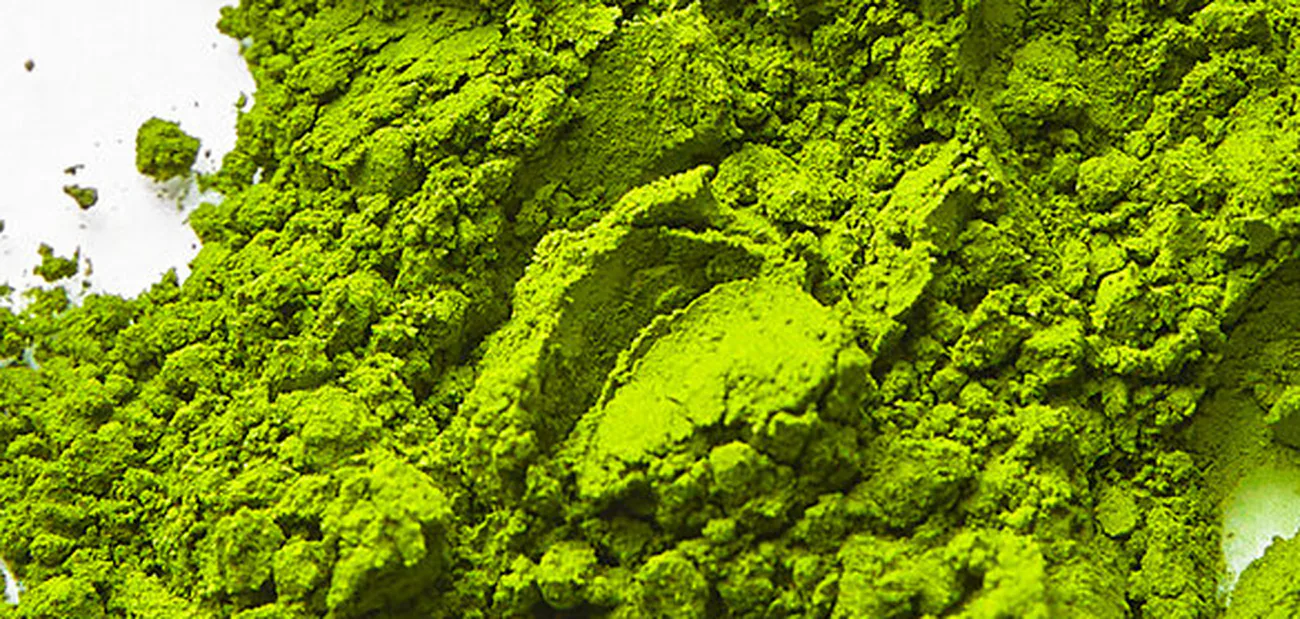
A standard serving of matcha is 2 g of powder, which gives 60–70 mg of caffeine. The figure depends on cultivar, harvest and degree of shading — first-harvest leaves, heavily shaded, usually carry more than later ones.
Matcha against other drinks
| Drink | Serving | Caffeine |
|---|---|---|
| Matcha (usucha) | 2 g / 70 ml | 60–70 mg |
| Matcha koicha (thick) | 4 g / 30 ml | 120–140 mg |
| Espresso | 30 ml | ~63 mg |
| Filter coffee | 240 ml | 95–120 mg |
| Green tea (infusion) | 240 ml | 25–35 mg |
| Black tea | 240 ml | 40–50 mg |
| Cola | 330 ml | ~32 mg |
| Energy drink | 250 ml | ~80 mg |
The conclusion: matcha is not a "caffeine-free" or "light" drink. It sits roughly at espresso level — higher than ordinary green tea, which many people use as their reference point.
"Matcha has more caffeine than coffee" — where the myth comes from
That sentence circulates widely and is simultaneously true and false, depending on what is being compared. The whole contradiction comes from confusing raw material with serving.
| Comparison | Matcha | Coffee |
|---|---|---|
| Caffeine in dry material | approx. 3.0–4.0% | approx. 1.2–1.5% |
| Material per serving | 2 g | 8–10 g |
| Caffeine per serving | 60–70 mg | 95–120 mg |
So a gram of matcha powder holds two to three times more caffeine than a gram of ground coffee — and that is the true half of the sentence. It is just that a cup of coffee takes four times as much material. Measured by what actually reaches the cup, coffee wins.
Anyone comparing "per 100 g" composition tables will see matcha at the top and draw the opposite conclusion. The practical rule: with caffeine, the serving is what counts, not the percentage in the raw material.
Where the caffeine in the leaf comes from
Caffeine is the plant's natural defence — bitter and off-putting to insects. The tea bush concentrates it where it has most to lose, namely in the youngest leaves and buds at the tip of the shoot. Hence:
- The first harvest carries more than the second and third — those are the youngest leaves.
- Shading before harvest raises the content of both caffeine and L-theanine. Deprived of part of the light, the plant shifts how it handles nitrogen compounds.
- The higher up the shoot, the more there is — which is why selective hand-picking matters.
This leads to a conclusion that surprises people: ceremonial matcha usually has more caffeine than culinary, not less. Ceremonial grade means younger, more heavily shaded leaves. Culinary grade, from later harvests and lower down the shoot, tends to be 20–30% weaker in this respect. We set out the difference between grades in ceremonial versus culinary matcha.
You drink the whole leaf — there is no extraction
This is the second thing that sets matcha apart from every other tea. When you steep leaves, only part of their compounds passes into the water — how much depends on temperature, time and how many times you refill. The rest stays in the leaves and goes in the bin.
Matcha is not steeped: you suspend it in water and drink all of it. One hundred per cent of the caffeine the powder held reaches you. That is why 2 g of matcha delivers more caffeine than 2 g of leaves steeped in water, even though the raw material is comparable.
The practical consequence: with matcha you control the dose with the scoop, not with steeping time. Leaving it in the water longer changes nothing.
Why it feels different from coffee at a similar dose
Here lies the whole difference, and there is no magic in it — it is chemistry. Matcha contains L-theanine, an amino acid found almost exclusively in tea. A serving delivers 20–40 mg of it, and because you drink the whole ground leaf there is more of it than in an infusion.
Research on caffeine combined with L-theanine consistently points to better sustained attention with less arousal than caffeine alone at the same dose. In practice this is described as calm focus: no sharp peak at 30 minutes and no crash two hours later. The energy spreads out, typically over 4–6 hours.
A second factor adds to it: matcha is drunk in small sips and slowly, coffee often in one go. The pace of intake also changes how the effect feels. We compare the two drinks at length here: matcha vs coffee →
How many servings a day
The commonly cited reference for healthy adults is up to 400 mg of caffeine a day from all sources. That works out at roughly 5–6 servings of matcha — but only if you are not also drinking coffee, cola or tea.
Realistically, 1–3 servings a day is the range most regular matcha drinkers settle into.
- In pregnancy and while breastfeeding the guidance is usually stricter — around 200 mg a day from all sources, roughly three servings. Worth discussing with the doctor overseeing your care.
- If you are caffeine-sensitive, start with one serving in the morning and watch your sleep.
Why one serving is plenty for some and three barely register for others
The rate at which the body breaks caffeine down varies several-fold between people — largely down to the liver enzyme CYP1A2, whose activity is genetically determined. Hence the people who drink espresso after dinner and sleep soundly, and the people for whom one cup at 2 p.m. costs a night.
Layered on top are factors you can control:
- Tolerance. With regular drinking the perceived effect fades within 1–2 weeks. That is normal and reversible.
- Body mass. The same dose means a different concentration in someone of 55 kg and someone of 95 kg.
- Food. Caffeine on an empty stomach is absorbed faster and hits harder.
- Medication. Some medicines markedly slow caffeine metabolism — if you take something regularly, ask your pharmacist.
How late you can drink it
Caffeine's half-life in adults averages 5–6 hours — after that time half the dose is still circulating. A matcha at 5 p.m. means roughly 30 mg still in your system at 11 p.m.
The practical cut-off for most people is eight hours before bed. If you are caffeine-sensitive, keep it to the morning.
A simple sensitivity test
Rather than guessing, find out in a week:
- For three days drink one serving, always at the same time in the morning. Note how you slept.
- For the next three days move that same serving to 3 p.m.
- Compare your notes. If sleep is unchanged, afternoon matcha is safe for you. If you take longer to fall asleep, keep it to the morning.
One variable at a time, with no coffee in the background. It is the only way to get an answer about you rather than about a statistical adult.
Can you lower the caffeine dose
Yes, and without giving up the drink:
- Reduce the serving to 1–1.5 g. The flavour stays, the caffeine falls proportionally.
- Choose usucha over koicha. Thick koicha is a double dose of powder.
- Dilute it in a latte. The caffeine dose is unchanged, but the drink takes longer, so absorption is slower.
- Shift the time. Often the problem is not the amount but the hour.
There is no such thing as "caffeine-free matcha" made from real leaf — caffeine is a natural component of the plant. If you come across such a product, check the ingredients; it is usually a blend with other materials.
If you are looking for matcha where you can actually feel the difference between stimulation and focus, start with ceremonial grade: see Avelor matcha →
How much caffeine is in one serving of matcha?
A 2 g serving contains about 60–70 mg of caffeine, roughly the same as an espresso. Thick koicha made with 4 g of powder comes to 120–140 mg.
Does matcha have more caffeine than coffee?
About the same as an espresso (63 mg), but less than a cup of filter coffee at 95–120 mg. Compared with ordinary green tea, however, matcha has distinctly more.
Why do I read that matcha has more caffeine than coffee?
Because those comparisons measure the raw material, not the serving. A gram of matcha holds 2–3 times more caffeine than a gram of ground coffee, but a cup of coffee uses four times as much material. Per cup, coffee wins.
Does ceremonial matcha have more caffeine than culinary?
Usually yes, which surprises many people. Ceremonial grade is made from the youngest, most heavily shaded leaves, and that is exactly where caffeine concentrates. Culinary matcha from later harvests can be 20–30% weaker.
Why does matcha not make me jittery the way coffee does?
Because of L-theanine, an amino acid found almost only in tea. Research on caffeine combined with L-theanine points to better attention with less arousal than caffeine alone at the same dose.
How much matcha can I drink a day?
The reference for healthy adults is 400 mg of caffeine a day from all sources, which is about 5–6 servings of matcha. In practice most regular drinkers settle between one and three.
How late can I drink matcha?
Caffeine has a half-life of 5–6 hours, so the practical limit for most people is around eight hours before bed. If you are caffeine-sensitive, keep it to the morning.
Does whisking matcha for longer increase the caffeine?
No. Matcha is not steeped — the powder is suspended in water and drunk whole, so you receive one hundred per cent of its caffeine regardless of whisking time. The dose is controlled purely by how much powder you use.
Is there such a thing as caffeine-free matcha?
Not as genuine ground tea leaf — caffeine is a natural component of the plant. Products described as caffeine-free are usually blends with other ingredients, so it is worth checking the label.