Matcha vs energy drinks and cola — caffeine and sugar compared per serving
The short answer: a serving of matcha has roughly as much caffeine as a small can of energy drink and twice as much as a can of cola — but no sugar unless you add it. The rest is serving arithmetic worth doing once.
“Matcha or an energy drink” is really three questions at once: how much caffeine, how much sugar and what else is in there. Each one has a number for an answer — provided you count what you actually drink, not the 100 ml on the label.
The short answer — a table per typical serving
| Drink | Serving | Caffeine | Sugar |
|---|---|---|---|
| Matcha | 2 g of powder | 60–70 mg | 0 g |
| Espresso (for reference) | about 30 ml | about 63 mg | 0 g |
| Classic cola | 330 ml | about 32 mg | about 35 g |
| Classic energy drink | 250 ml | about 80 mg | about 27 g |
| Classic energy drink | 500 ml | about 160 mg | about 54 g |
| Sugar-free cola or energy drink | as above | the same | 0 g (sweeteners) |
These are typical values — exact figures depend on the manufacturer and are printed on the label. With matcha the range comes from the raw material itself: the harvest, the grade of the powder and whether the serving really weighs 2 g. More on where the numbers come from: how much caffeine is in matcha.
Per 100 ml or per serving — where the confusion starts
Energy drink labels state caffeine per 100 ml because the law requires it. That is a fair unit for comparing two cans, but a misleading one when you compare drinks consumed in completely different volumes.
| Drink | Caffeine per 100 ml | Caffeine per serving |
|---|---|---|
| Cola | about 10 mg | about 32 mg (330 ml) |
| Classic energy drink | about 32 mg | about 80 mg (250 ml) / about 160 mg (500 ml) |
| Matcha with water (2 g in 70 ml) | about 90 mg | 60–70 mg |
| Matcha latte (2 g in 250 ml) | about 26 mg | 60–70 mg |
The same serving of matcha looks “three times stronger than an energy drink” or “weaker than an energy drink” depending on how much water or milk you pour over it. The caffeine is identical in both versions. That is why the serving is what counts — the amount you actually finish.
Cans have the opposite problem: a 500 ml can is two 250 ml “servings”, yet hardly anyone drinks half and puts the rest away. In practice one large can means about 160 mg of caffeine and more than 50 g of sugar in the sugared version.
What else is in the can, and what is in the bowl
A classic energy drink usually contains water, sugar or sweeteners, carbon dioxide, acidity regulators (citric acid, for example), caffeine, taurine, B vitamins, flavourings and colours. Cola is water, sugar or sweeteners, carbon dioxide, caramel colour, phosphoric acid, flavourings and caffeine.
Matcha has one ingredient: the whole tea leaf, ground. You do not steep it and throw the leaves away — you drink the entire leaf, so along with caffeine you get what the leaf naturally contains, including L-theanine (the amino acid behind the umami taste) and catechins. We describe this as composition, not as a promise of any effect.
- Caffeine — present in both, and the same molecule whatever the source.
- Sugar — 27–54 g in a sugared can; none in matcha made with water.
- Acids and carbonation — in the can, not in matcha.
- Taurine and added B vitamins — in the energy drink, not in matcha.
- L-theanine and catechins — naturally in the tea leaf, usually absent from the can.
Why people describe the two experiences differently
Many people say an energy drink “kicks in” fast and “drops off” fast, while matcha feels more even. Three reasons can be named for why those descriptions may differ — without promising that it will be the same for you.
- Sugar. A sugared can is caffeine plus several dozen grams of rapidly absorbed sugar at once. Part of what people call the “crash” may be a description of their response to sugar rather than to caffeine.
- L-theanine. Studies on the combination of caffeine and L-theanine describe a different subjective experience than with caffeine alone. They concern specific doses under study conditions, though, not a cup of a particular tea — treat this as context, not a guarantee.
- Speed of drinking. A cold, sweet, carbonated drink is gone in a few minutes. Warm matcha is sipped more slowly, so the caffeine arrives at a different pace too.
Caffeine itself behaves the same whatever the source: its half-life in adults is 5–6 hours. We cover this in more depth in how long matcha lasts and matcha vs coffee.
To be honest: a matcha latte with syrup is not “sugar-free” either
Zero grams of sugar applies to matcha made with water. A glass of cow’s milk (200 ml) carries about 9–10 g of natural milk sugar, and every pump of syrup in a café adds another 7–10 g. A large matcha latte with two pumps of syrup can therefore hold as much sugar as a small can of energy drink. If sugar is your reason for choosing matcha, order it without syrup or make it at home. Exact figures for different milks: calories in a matcha latte.
The daily sum — how cans and matcha add up
The European Food Safety Authority (EFSA) considers up to 400 mg of caffeine a day from all sources and up to 200 mg in a single dose safe for healthy adults. During pregnancy and breast-feeding: up to 200 mg a day. Caffeine from a can, from coffee and from matcha all counts towards the same total.
- A 500 ml can + two servings of matcha: about 160 + 120–140 = 280–300 mg.
- Two 500 ml cans + one matcha: about 320 + 60–70 = 380–390 mg — practically the whole daily amount.
- A 500 ml can and an espresso one after the other: about 223 mg — above 200 mg in a single dose.
- Three servings of matcha across the day: 180–210 mg.
How to space servings through the day is covered separately: how much matcha a day.
What the label says — and what it does not tell you
In the European Union, drinks containing more than 150 mg of caffeine per litre must carry the statement “High caffeine content. Not recommended for children or pregnant or breast-feeding women” together with the caffeine content in mg per 100 ml. Energy drinks (about 320 mg/l) exceed that threshold; cola (about 100 mg/l) does not.
The requirement does not apply to drinks based on coffee or tea whose name includes the word “coffee” or “tea”. So the absence of that sentence does not mean there is no caffeine — matcha contains it: the same caution applies to children, pregnancy and breast-feeding. Details and the pregnancy arithmetic: matcha during pregnancy. If in doubt, ask a doctor.
In practice: swapping the afternoon can for an iced matcha
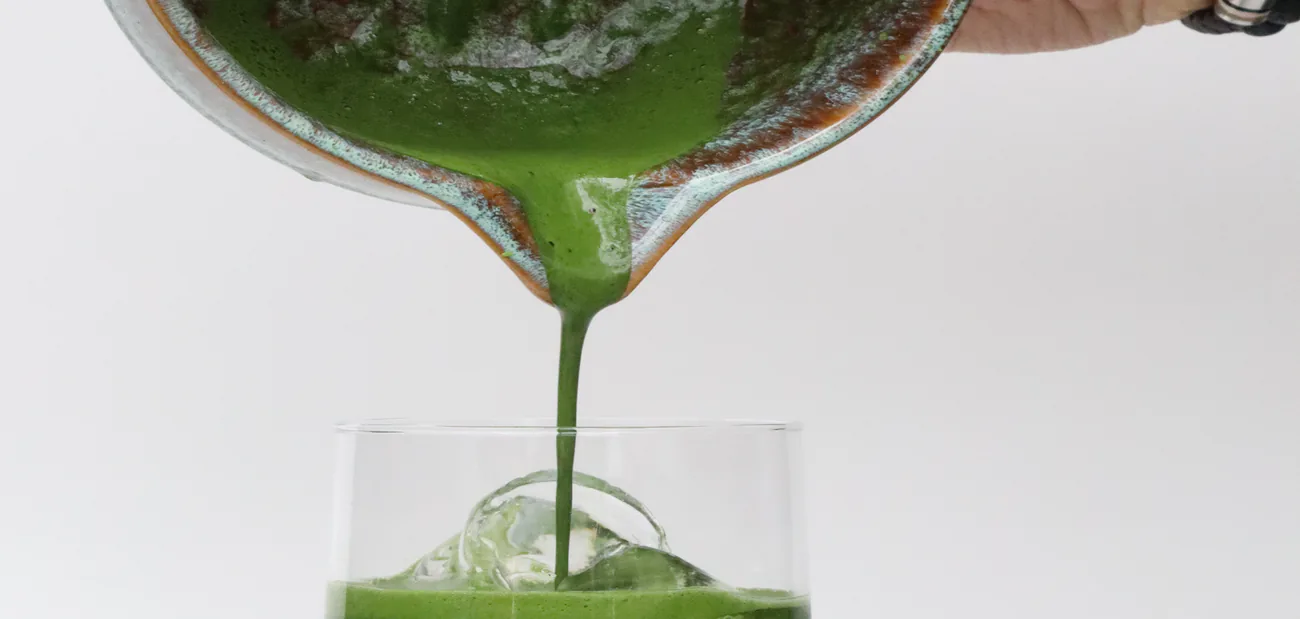
If what you like most about an energy drink is that it is cold and ready in a minute, the closest equivalent is cold matcha: 2 g of powder shaken in a bottle with 300 ml of water and ice. That is 60–70 mg of caffeine — a little less than a small can — and 0 g of sugar. Step-by-step recipe: cold matcha. Mind the time: the last serving of caffeine should fall at least 8 hours before bed, whatever the source.
For cafés, iced matcha is a simple menu item for guests who want something cold with caffeine in the afternoon but do not want a can. Wholesale terms are on our business page, and powder for home is here: ceremonial matcha.
What we do not promise
Matcha is not “healthy energy” and not a remedy for tiredness. We do not promise better concentration, the absence of a “crash” or any health effect. What can honestly be said is this: it is a different drink — with a known dose of caffeine, a single ingredient and no sugar unless you add it yourself. Whether it suits you better than a can is something only trying it will tell you.
Does matcha have more caffeine than an energy drink?
A serving of matcha made from 2 g of powder has 60–70 mg of caffeine, while a classic energy drink has about 80 mg per 250 ml can and about 160 mg per 500 ml can. A small can and a serving of matcha are therefore close, and a large can equals more than two servings of matcha.
How much caffeine does matcha have compared to cola?
A 330 ml can of cola has about 32 mg of caffeine; a 2 g serving of matcha has 60–70 mg, roughly twice as much. Sugared cola, however, contains about 35 g of sugar, while matcha made with water contains 0 g.
Can matcha replace an energy drink?
In terms of caffeine, yes: a serving of matcha delivers a similar amount to a small can. It is a different drink, though — no sugar, carbonation or taurine — and we do not promise the experience will be the same or better.
Does a matcha latte have less sugar than an energy drink?
It depends on how it is made. Matcha with water has 0 g of sugar, but 200 ml of cow’s milk brings about 9–10 g of milk sugar and each pump of syrup adds 7–10 g. A large latte with syrup can match a small can of sugared energy drink.
How much matcha and energy drink can you have in a day?
EFSA considers up to 400 mg of caffeine a day from all sources, and up to 200 mg in a single dose, safe for healthy adults. A 500 ml can (about 160 mg) plus two servings of matcha (120–140 mg) comes to 280–300 mg.
Is matcha suitable for children or during pregnancy instead of energy drinks?
Matcha contains caffeine too, so the same caution applies as with energy drinks. For pregnancy and breast-feeding EFSA indicates up to 200 mg of caffeine a day from all sources; if in doubt, ask a doctor.