How many calories are in a matcha latte — and where they really come from
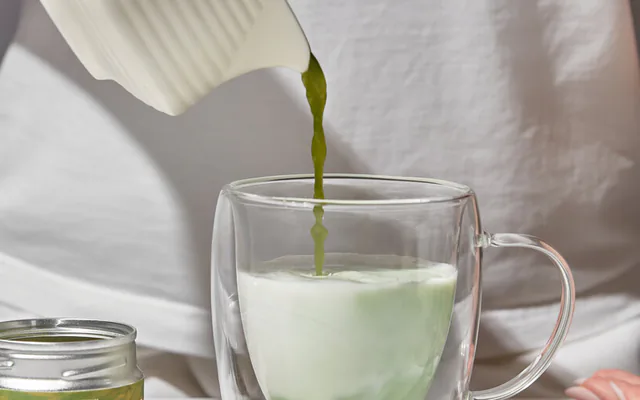
The question "how many calories are in a matcha latte" has one honest answer: it depends entirely on what you pour in. The powder itself counts for almost nothing — milk and syrup do all the work. Below are the numbers you need to build any version.
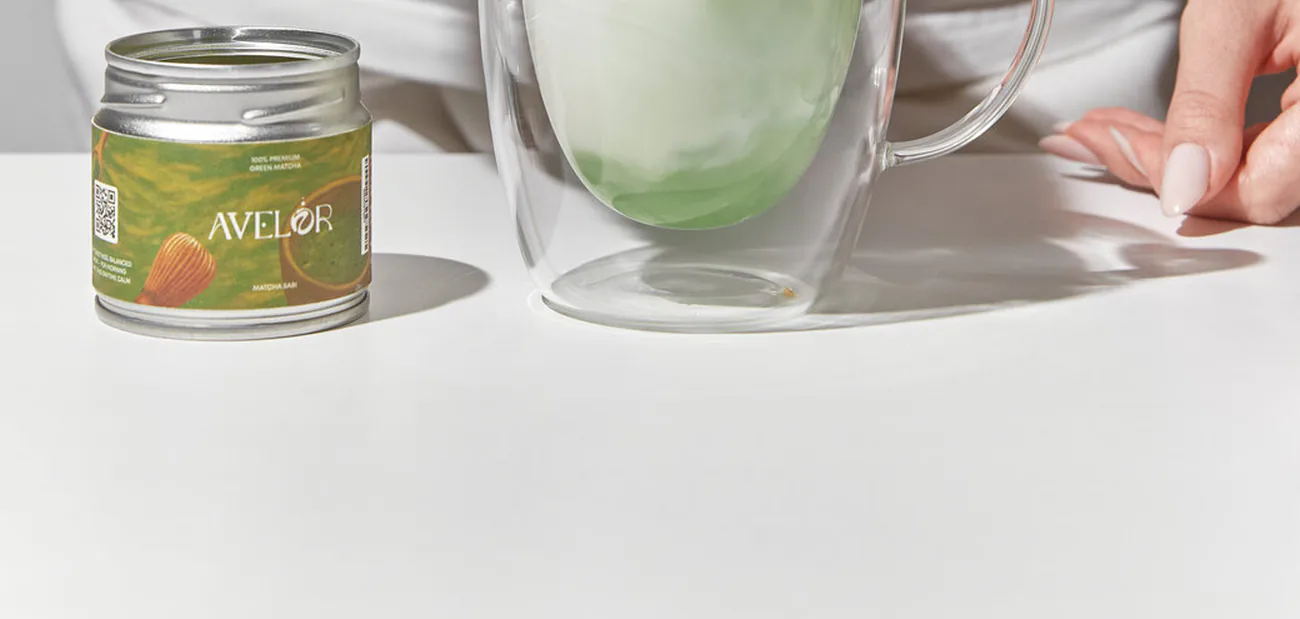
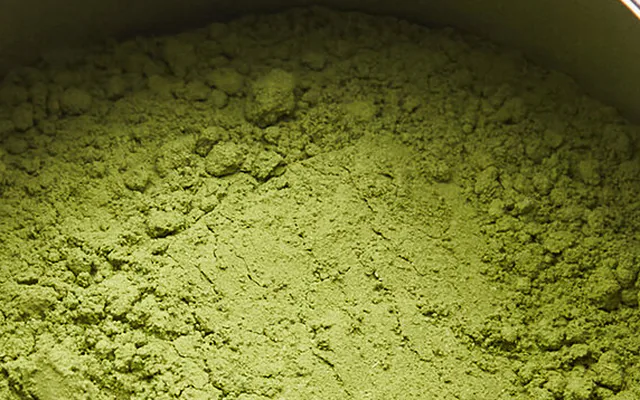
Start with a reference point. A serving of plain matcha (2 g of powder in water) is in the range of 5–10 kcal. That is less than a sugar cube. Everything above that figure, you add yourself.
The milk decides everything
A typical matcha latte holds 200–250 ml of milk. Below are values for 200 ml, rounded — exact figures vary between producers and are always on the carton.
| Milk (200 ml) | Approximately |
|---|---|
| Dairy, whole (3.2%) | 120–130 kcal |
| Dairy, semi-skimmed (2%) | 95–105 kcal |
| Dairy, skimmed (0.5%) | 70–75 kcal |
| Oat, barista | 110–130 kcal |
| Oat, standard | 85–100 kcal |
| Soy, unsweetened | 75–90 kcal |
| Almond, unsweetened | 25–35 kcal |
| Coconut drink | 40–60 kcal |
The biggest surprise for many people: oat milk is not the "light" option. The barista version, formulated for foaming, usually carries as many calories as dairy or more — it contains added fat, and the starch broken down during production yields simple sugars.
Beyond calories — what else the milk brings
A kilocalorie figure alone rarely settles a decision. Here is the same 200 ml broken down by what actually differs between these drinks:
| Milk (200 ml) | Protein | Sugars |
|---|---|---|
| Dairy 2% | 6–7 g | 9–10 g (lactose) |
| Soy, unsweetened | 6–7 g | 0–1 g |
| Oat, barista | 1–2 g | 6–9 g |
| Almond, unsweetened | 1–1.5 g | 0–1 g |
Two practical conclusions follow. If you care about satiety and protein, dairy and soy come out best. If you are counting calories alone, almond wins — but the drink will be thinner and less filling, because it is largely water with a modest amount of almond.
It is also worth knowing that the sugars in dairy and in oat milk are two different stories. Lactose occurs naturally in milk and is not an added sugar. The sugars in oat milk arise from starch broken down during production — formally not "added" either, but they behave in the body like simple sugars.
Syrup — the other half of the bill
One pump of flavoured syrup is typically 20–40 kcal. Two is the café standard, and a large cup often gets three. That can add more than half a serving of milk.
| Sweetener | Portion | Calories |
|---|---|---|
| Flavoured syrup | 1 pump (10 ml) | 20–40 kcal |
| Honey | 1 teaspoon | ~20 kcal |
| Maple syrup | 1 teaspoon | ~17 kcal |
| White sugar | 1 teaspoon | ~20 kcal |
| Erythritol / stevia | 1 teaspoon | 0–4 kcal |
A separate category is ready-made "matcha latte" powder blends. Many are mostly sugar — matcha there is a flavouring, not a base. If sugar comes before tea in the ingredients, it is a sugary drink that happens to be green, and counting the calories of the matcha itself makes no sense.
How to read the label on a ready-made blend
Three things to check before you buy:
- Ingredient order. They are listed by descending quantity. Sugar in first place settles the matter.
- The "per 100 g" table. If sugars exceed 50 g per 100 g of product, this is sugar with added matcha.
- Tea content. Sometimes stated outright as a percentage. Below 30% it is hard to call it a matcha drink.
The alternative is simpler and cheaper per serving: plain powder plus the milk you already have. We described the quality difference in how to recognise good matcha.
Three real examples
| Version | Composition | Total |
|---|---|---|
| Plain usucha | 2 g matcha + water | ~10 kcal |
| Light home latte | 2 g + 200 ml almond milk | ~40 kcal |
| Classic latte | 2 g + 200 ml dairy 2% | ~110 kcal |
| Café latte | 2 g + 250 ml oat + 2 pumps syrup | ~200–230 kcal |
For comparison: a caffè latte made with 2% milk at the same volume comes out much the same. A matcha latte is neither a "diet alternative to coffee" nor anything worse — the difference sits in the additions, not in the tea.
Cup size multiplies only one thing
In a café, going from a small cup to a large one usually does not change the amount of matcha — the barista scoops the same portion of powder and pours in more milk. Volume rises, calories rise, and the matcha flavour is diluted.
So the smaller size is usually better in both directions: fewer calories and a clearer tea flavour. If you want a bigger drink without dilution, ask for a double portion of matcha — that adds practically no calories.
Iced is the same calories
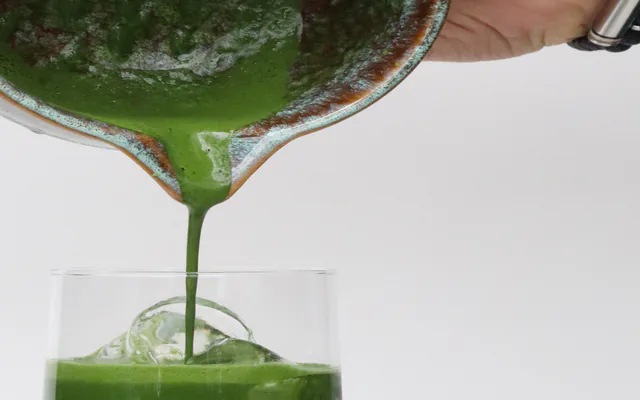
The iced version is often assumed to be lighter because it is refreshing. In fact ice adds no calories, but it subtracts none either — what counts is the milk and the syrup, exactly as in the hot version. The real difference is more interesting: at low temperatures fewer catechins come out of the powder, so the drink tastes naturally sweeter and more often needs no sweetening at all. Recipe: iced matcha →
How to order a lighter version
- Ask for no syrup. It is usually the single biggest item after the milk.
- Choose unsweetened almond milk if the numbers matter most, or skimmed dairy if protein does.
- Take the smaller size. The matcha in the cup is usually the same; only the milk grows.
- Ask for half milk, topped up with water. It works better than it sounds — matcha does not need full dairy to feel creamy.
- Ask whether it is matcha or a blend. A good café will answer without hesitating.
The version with no milk calories
If what you want is the flavour of matcha rather than milky comfort, drink it with water. In summer the iced version works best. If you stay with milk, technique matters for taste rather than calories — well-foamed milk tastes sweeter at the same sugar content: matcha latte recipe →
What matcha will not do
This category attracts plenty of promises about "burning fat" and "boosting metabolism". European law does not permit attributing medicinal or slimming effects to food without an authorised claim, and we make none here. Matcha is neither a slimming aid nor an obstacle — it is a drink whose calorie content depends on what you pour into it. What research on the leaf's components actually shows: matcha benefits →
How many calories are in a matcha latte?
From about 40 kcal (2 g of matcha in 200 ml of unsweetened almond milk) to over 200 kcal for a café version with oat milk and two pumps of syrup. The matcha itself is only 5–10 kcal.
How many calories are in plain matcha with water?
In the range of 5–10 kcal per serving made with 2 g of powder, which is less than a sugar cube. In practice it is negligible in a day of eating.
Is oat milk lighter than dairy?
Usually not. The barista version, formulated for foaming, carries as many calories as dairy or more, because it contains added fat and sugars formed from broken-down starch.
Which milk gives the fewest calories in a matcha latte?
Unsweetened almond milk, at about 25–35 kcal per 200 ml. It is low in protein and gives a thinner drink, though. If satiety matters, skimmed dairy or unsweetened soy is the better choice.
Is a matcha latte lighter than a coffee latte?
With the same milk and the same volume the difference is small — the calories come from the milk, not from matcha or coffee. Syrup and cup size decide the total.
Does an iced matcha latte have fewer calories?
No. Ice adds no calories but subtracts none either — the milk and sweetening are what count. The iced version does tend to taste naturally sweeter, because fewer catechins come out at low temperature, so it more often needs no syrup.
Does a bigger cup mean more matcha?
Usually not. The barista scoops the same portion of powder and adds more milk, so only the calories grow while the tea flavour is diluted. For a larger drink without dilution, ask for a double portion of matcha.
How do I tell a ready-made blend from pure matcha?
By the ingredients: if sugar comes before tea, or sugars exceed 50 g per 100 g of product, it is a sugary green drink. Pure matcha has one ingredient — ground tea leaf.
Does matcha help with weight loss?
We do not attribute slimming effects to food — European law does not allow it without an authorised claim. Matcha without additions is a practically calorie-free drink, and that is all one can honestly say about it.