Which milk for a matcha latte — dairy, oat, soy, almond and coconut in one comparison
Milk is three quarters of a matcha latte by volume, so it decides the taste, foam and colour more than the powder itself. There is no single best milk — there is a best for hot, a best for iced and a lightest. The table is below, the reasoning follows.
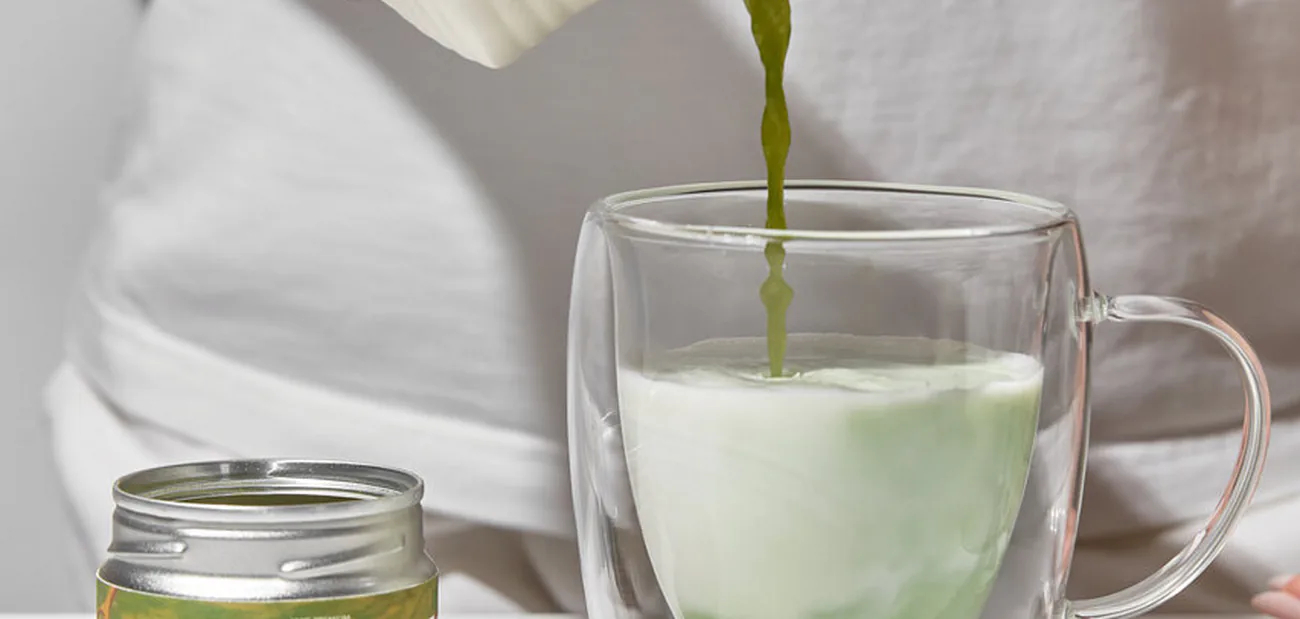
In a matcha latte recipe there are 2 g of powder and 150–200 ml of milk. The milk provides body, sweetness, foam and the background for the colour; the matcha provides flavour and colour. If a latte comes out flat, grey or separated, nine times out of ten the milk is to blame, not the powder. Below, the six most common milks against the four criteria that really matter: foam, taste, colour and behaviour when iced.
The short answer
- Hot, classic: whole dairy (3.2 %) or barista oat — the thickest foam, the fullest taste.
- Iced: barista oat — it does not separate on ice and holds layers.
- Lightest: unsweetened almond — 25–35 kcal per 200 ml, but thin foam and a distinct taste of its own.
- Lactose-free with protein: soy — foam like dairy, as long as there is no acid in the drink.
- For dessert versions: coconut (barista version), which suits ube and sweet syrups.
Table: six milks, four criteria
| Milk | Foam | Taste with matcha | Latte colour | Calories (200 ml) |
|---|---|---|---|---|
| Dairy 3.2 % | thick, lasting | full, slightly sweet, neutral | light, clean green | 120–130 kcal |
| Dairy 2 % | good, a little lighter | neutral, less body | light green | 95–105 kcal |
| Barista oat | thick, creamy | slightly sweet, cereal, does not dominate | green with a beige tint | 110–130 kcal |
| Unsweetened soy | good, stable | distinctly beany with a weaker matcha | yellowish green | 75–90 kcal |
| Unsweetened almond | thin, collapses quickly | nutty, covers a delicate matcha | greyish green | 25–35 kcal |
| Coconut (drink) | weak; barista — good | sweet, dessert-like | green with beige | 40–60 kcal |
Calories as in the matcha latte calorie table; they refer to the milk alone, without syrup. Matcha adds about 6 kcal per serving.
Foam: why some milks foam and others do not
Foam is made by protein (the walls of the bubbles) and fat (their stability). Dairy milk has 6–7 g of protein per 200 ml plus fat — hence the thickest foam. Soy has the same amount of protein, so it foams just as well. Ordinary oat milk has 1–2 g of protein and foams poorly; the barista version has added plant fat and an acidity regulator, which give a thick, lasting foam despite the low protein — that is the whole difference between "oat" and "barista oat". Almond and coconut drinks have too little of both: the foam comes out thin and collapses before you can pour it.
The temperature is the same for all of them: 60–65 °C. Above 70 °C the protein coagulates, the foam turns dry and coarse-bubbled, and the milk loses its sweetness — regardless of the type.
Taste: which milk does not cover the matcha
Matcha tastes of umami and a gentle bitterness, and its sweetness is quiet. The milk should lift that, not cover it:
- Dairy — the most neutral background; lactose gives natural sweetness, so a latte on whole milk often needs no syrup.
- Oat — slightly sweet and cereal-like; it joins matcha so naturally that it has become the default choice in cafés. It does not dominate even a mild matcha.
- Soy — neutral with an intense matcha, "beany" with a mild one. Works with IKI, less well with SABI.
- Almond — a distinct nuttiness which, with the umami of matcha, makes an interesting pairing for some and simply takes the matcha's taste away for others. It needs a stronger dose: 3 g instead of 2.
- Coconut — sweet and dessert-like; excellent in an ube latte and in sweetened versions, too dominant in a plain matcha latte.
If a latte is bitter, changing the milk rarely helps — the causes are usually in the powder and the water temperature, which we cover in why matcha is bitter.
Colour: white milk, green latte
The colour of a matcha latte is the colour of matcha diluted by the colour of the milk. White milks — dairy, soy — give a clean, light green. Oat and coconut are beige, so the green shifts to khaki. Almond can be greyish. In photos and in layered drinks, dairy and barista oat (which has less beige than the ordinary kind) look best. The matcha itself must be ceremonial: culinary grade is olive and no milk will fix that.
Iced: which milk separates
In an iced matcha latte the milk does not have to foam, but it has to withstand ice and any additions:
- Barista oat — the most stable: it does not separate, does not curdle, holds layers. The safe default.
- Dairy — just as good; whole milk gives a clearer white layer than skimmed.
- Soy — curdles into flakes with acid: lemon syrup, strawberries, lemonade. In a plain iced latte it is fine.
- Almond and coconut drinks — thin, the layers vanish after a moment; fine for taste, not for looks.
Milks you ask about less often
- Pea — plenty of protein, foam like soy, a more neutral taste than soy. Hard to find, but if available — a good lactose-free choice.
- Rice — watery and sweet, does not foam; not for lattes.
- Lactose-free dairy — identical to ordinary dairy in foam and colour, slightly sweeter (the lactose is broken down into simpler sugars).
- Milk powder and cream — a tablespoon of 30 % cream in skimmed milk rescues the foam and the body; a café trick that works at home too.
For cafés: one default milk, one "light"
A menu does not need six milks. A pair works: barista oat as the default (no surcharge, because it suits matcha best and does not separate iced) plus dairy for guests who expect it, with almond as an optional "light". Barista oat is also the most convenient for the barista: one temperature, one technique, a repeatable result. More on matcha on a café menu and the cost per serving are in separate articles.
Where to start
The simplest test: the same matcha, three milks, three small lattes side by side — the differences are visible and tasteable at once. For the test, the mild SABI 30 g shows which milk covers the taste; the intense IKI 30 g shows which lifts it. Both together: the IKI & SABI duo.
Which milk is best for a matcha latte?
Hot — whole dairy (3.2 %) or barista oat: both give a thick foam and a full taste that does not cover the matcha. Iced — barista oat, because it does not separate on ice. The lightest is unsweetened almond, but it has a thin foam and a distinct taste of its own.
Does oat milk go with matcha?
Yes, it is the most common choice in cafés: a slightly sweet, cereal background that joins the umami of matcha without dominating. For foam you need the barista version — ordinary oat milk has only 1–2 g of protein per 200 ml and foams poorly.
Why does soy milk curdle in a matcha latte?
Soy protein coagulates with acid — lemon syrup, fruit, lemonade — and with high heat. In a plain matcha latte heated to 60–65 °C soy behaves well and foams like dairy; the problem appears with acidic additions.
Which milk for a matcha latte has the fewest calories?
Unsweetened almond: 25–35 kcal per 200 ml. Then coconut drink 40–60 kcal, dairy 0.5 % 70–75 kcal and unsweetened soy 75–90 kcal. Whole dairy has 120–130 kcal and barista oat 110–130 kcal per 200 ml.
Why does my plant-milk foam collapse?
Too little protein and fat — ordinary oat, almond and coconut drinks have little of either. A barista version (added plant fat), a tablespoon of 30 % cream or a switch to soy helps. The second cause is overheating: above 70 °C every foam turns dry and coarse-bubbled.
Which milk gives the prettiest matcha latte colour?
White milks — dairy and soy — give a clean, light green. Oat and coconut are beige, so the latte shifts to khaki; almond can be greyish. The common condition: ceremonial matcha, because culinary grade is olive and no milk will change that.
Try it yourself