What is ube — the purple yam, its taste, its colour and how to use it in the kitchen
Ube is the purple tuber of a yam that has been the base of Filipino desserts for generations and, more recently, of purple lattes. It is not a sweet potato, not taro and not a tea — and it pays to know how its colour behaves before it goes into a cake or a lemonade.
The question “what is ube” usually comes up in front of a purple latte in a café or a photo of lavender-coloured ice cream. The answer is short: ube is an edible tuber, not a colouring, a fruit or a kind of tea. The rest of this guide is the practical detail — taste, colour, the usual mix-ups and how to use the powder.
Ube — the short answer
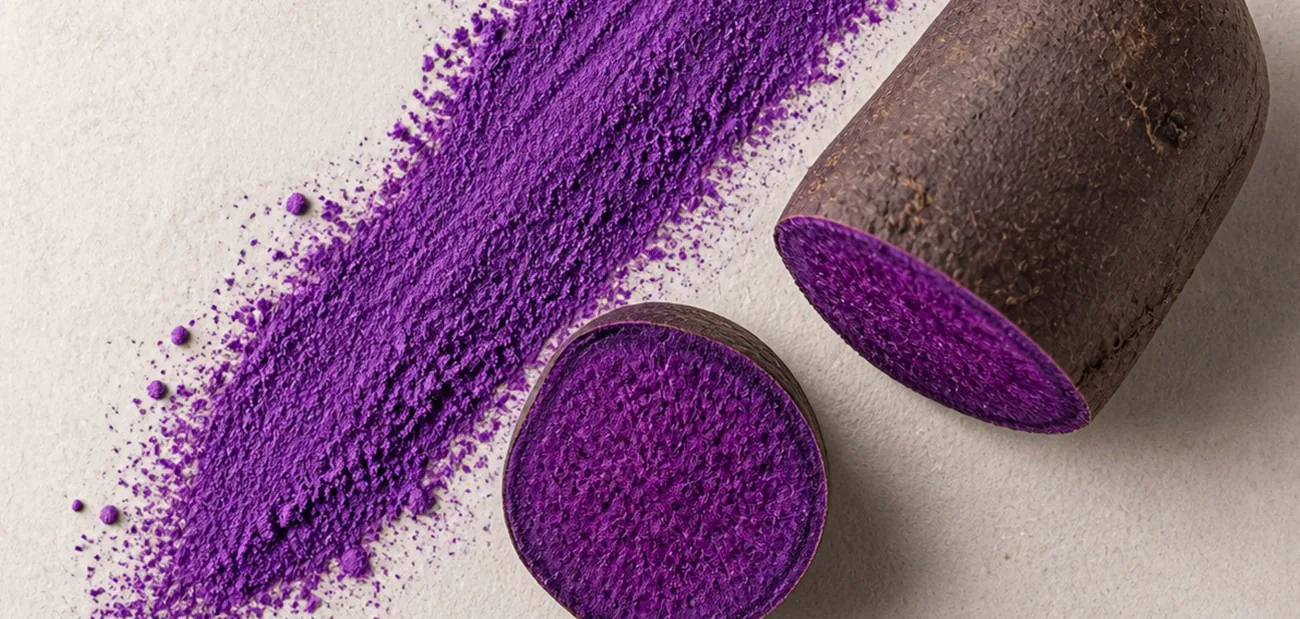
Ube (a Tagalog word, pronounced “OO-beh”) is the tuber of the purple yam, Dioscorea alata, from the yam family, Dioscoreaceae. Outside it is grey-brown and rough like bark; inside, depending on the variety, it runs from pale lavender to deep violet. It is only ever eaten cooked: boiled, baked, grated into a paste, or dried and ground into powder.
In Filipino cooking ube is first and foremost a dessert ingredient. The best known is ube halaya — a thick jam of grated tuber cooked with milk and sugar — followed by ice cream, cakes, soft bread rolls and the layered dessert halo-halo.
Ube is often loosely called a “purple sweet potato”. It is a convenient shorthand but an inaccurate one: the sweet potato is a different plant from a different botanical family. Ube is a yam.
What does ube taste like
Ube tastes gently sweet and creamy, with vanilla and nutty notes — which is also how we describe our own powder. Many people compare it to vanilla crossed with pistachio or white chocolate. It has none of the earthiness of beetroot and no pronounced starchy potato note.
It is a delicate flavour, not a dominant one. Dairy, oat and coconut milk carry it well, as do vanilla and white chocolate. It is easily buried under a lot of syrup, strong coffee or cocoa — at which point all that is left of the ube is the colour.
Why ube is purple
The colour comes from anthocyanins — the same group of plant pigments that colours red cabbage and blueberries. We write about them strictly as pigments: the purple colour is not a health promise and should not be read as one.
Anthocyanins have one property that genuinely matters in the kitchen: they behave like a pH indicator.
- Acidic surroundings (lemon juice, fruit, yoghurt) — the colour shifts towards pink and red.
- Close to neutral (milk, water) — purple or lavender.
- Alkaline surroundings (baking soda) — a bluish or greenish-grey tone.
There are two practical consequences. First, a cake raised with baking soda alone can come out of the oven grey-blue instead of purple. Baking powder in place of soda helps, as does an acidic ingredient in the batter: yoghurt, buttermilk, a little lemon juice. Long baking at high heat dulls the colour as well. Second, a lemonade or any citrus drink will turn more pink than purple — that is pigment chemistry, not a fault in the product. Matcha changes colour in the oven too, though for a different reason: baking with matcha.
Ube vs taro vs purple sweet potato
These three are confused constantly, including on labels and drinks menus. Botanically they have very little in common.
| Ube | Taro | Purple sweet potato | |
|---|---|---|---|
| Plant and family | purple yam (Dioscorea alata), yam family | taro (Colocasia esculenta), arum family | sweet potato (Ipomoea batatas), bindweed family |
| Flesh colour | lavender to deep violet | white or cream with purple flecks | purple, usually dark and matt |
| Taste | gently sweet, creamy, vanilla and nut | starchy, lightly nutty, barely sweet | sweet, drier and mealier, less vanilla-like |
| Typical use | desserts, ice cream, baking, milk drinks | savoury dishes, bubble tea, desserts | roasted, mashed, in baking |
One note on taro: the corm itself is pale. The vivid purple of many “taro” drinks usually comes from added colouring, not from the plant — so the colour in the cup does not yet tell you what is in it.
The forms ube is sold in
- Fresh tuber — rare in Europe, occasionally found in Asian grocers. Needs peeling and cooking.
- Frozen grated ube — a handy base for halaya and cakes if you have access to an Asian freezer section.
- Halaya, or ube jam — a ready, sweetened dessert product; too thick and too sweet for drinks.
- Extract or flavouring — a small bottle that gives mostly aroma and colour. It is a flavouring, not the tuber.
- Powder — dried, ground ube. It keeps well, is easy to measure and is the one form that works comfortably in both drinks and batters.
How to use ube powder
There is one rule and it applies to every use: first blend the powder with a little warm water or milk into a smooth paste, and only then add the rest of the liquid. Tipped straight into a full glass, it clumps.
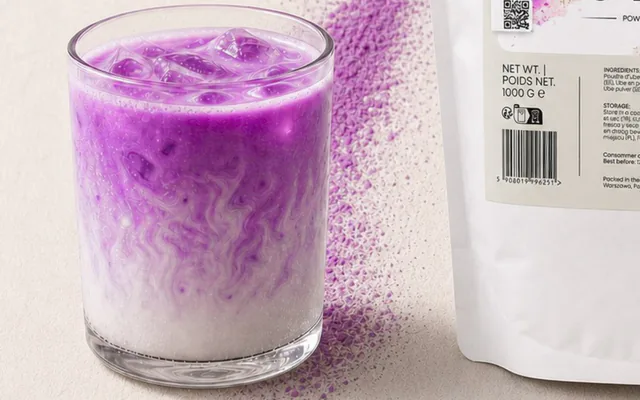
- Ube latte — 2–3 g of powder per drink, a paste, then steamed milk. Full ratios: ube latte recipe.
- Iced — the same paste, cold milk and ice. The colour looks its best in a glass over ice.
- Smoothies and shakes — with banana, coconut milk, yoghurt; with sharp fruit, expect a pink tint.
- Desserts — creams, no-bake cheesecake, panna cotta, ice cream, porridge.
- Baking — mix the powder into the dry ingredients and start with a small amount, increasing it by colour and taste.
How to read the label on an ube product
The word “ube” on a pack can mean very different things. With any product — whatever the brand — a few points in the ingredients list are worth checking:
- Powder or flavouring? “Ube powder” and “ube flavouring” are two different products with different uses.
- Where does ube sit in the list? Ingredients are listed in descending order by weight.
- Is there added sugar or milk powder? Ready “ube latte” mixes often contain them — which changes both dosing and sweetness.
- Are there colourings? A very intense, neon purple is sometimes the work of a colouring, not of the tuber.
And the country of origin: the fact that ube is associated with Filipino cooking says nothing about where a particular powder comes from. Always read that from the label, not from the product name.
Ube has no caffeine
Ube is a tuber, not a tea, so it is naturally caffeine-free. That is a basic difference from matcha, where a 2 g serving carries 60–70 mg of caffeine — more on that in what is matcha. An ube latte can therefore be drunk in the evening or served to someone who avoids caffeine. That implies no special effect of any kind: it is simply a drink without caffeine.
Ube on a café menu
In a café, ube solves two things at once: it gives you a caffeine-free option and a purple drink next to green matcha, which looks good in the display and in photos. The bar routine is the same as for a matcha latte — a paste from the powder, then milk — so no new equipment is needed. Write the recipe down in grams, because colour and taste respond quickly to the dose. For 500 g and 1 kg packs and trade terms, see our wholesale offer.
How to store ube powder
Dry, dark, in a tightly closed tin or pack, away from the hob and from steam. Moisture makes the powder cake, and light gradually dulls the colour. Always use a dry spoon.
Where to start
A latte is the easiest way in: one glass is enough to judge both taste and colour. The 10 g ube sample makes 3–5 servings — enough for a hot version, an iced one and one try in a dessert. For regular use at home, ube 50 g is a sensible size; the powder also comes in 100 g, 500 g and 1 kg packs.
What is ube?
Ube is the purple tuber of the purple yam (Dioscorea alata) and the base of many Filipino desserts. It is eaten cooked and, outside Asia, is most often found as a powder, a frozen paste or the jam called halaya. It is not a sweet potato, taro or a tea.
What does ube taste like?
Ube is gently sweet and creamy, with vanilla and nutty notes; it is often compared to vanilla crossed with pistachio or white chocolate. The flavour is delicate, so it works best with milk and is easily buried under a lot of syrup or coffee.
What is the difference between ube, taro and purple sweet potato?
They are three different plants from three botanical families. Ube (a yam) has purple flesh and a vanilla-nutty taste, taro is pale with purple flecks and tastes starchy and nutty, and purple sweet potato is sweet, drier and less vanilla-like.
Does ube have caffeine?
No. Ube is a tuber, not a tea, so it is naturally caffeine-free. By comparison a 2 g serving of matcha contains 60–70 mg of caffeine, which is why cafés often offer ube latte as the caffeine-free option next to matcha.
Why does ube change colour in cake or lemonade?
The purple pigments in ube, anthocyanins, react to pH. In acidic surroundings such as lemon juice the colour turns pink, and in alkaline ones such as baking soda it turns bluish or greenish-grey. In baking, using baking powder instead of soda or adding an acidic ingredient like yoghurt helps keep the purple.
How much ube powder do I need for one latte?
One drink takes 2–3 g of powder, so a 10 g sample makes 3–5 servings. Blend the powder with a little warm water or milk into a smooth paste first and only then add the rest of the milk — otherwise it clumps.