Matcha latte — hot and iced recipe (and why yours turns out bitter)
Café matcha latte is creamy and gently sweet; the homemade one is bitter and lumpy. The difference is not a five-figure espresso machine — it comes down to three things: the ratio, the water temperature and the order you do things in. Here are all three.
Matcha latte is the most ordered matcha drink in the world and also the easiest one to ruin. The reason is simple: matcha does not dissolve in milk. Tip the powder straight into a mug and pour hot milk over it, and you get lumps suspended in fat — plus bitterness, because the milk never distributes the powder evenly.
There is one fix, and it never changes: make the matcha with water first, add milk second. That single rule solves most problems.
Ratios — everything depends on them
- 2 g of matcha — a heaped teaspoon, or 1.5–2 scoops of a bamboo chashaku.
- 50–60 ml of water at 70–80 °C — for whisking the base.
- 150–200 ml of milk — dairy or plant-based.
If you are building a latte in a large mug (300–400 ml), raise the matcha to 3 g. At 2 g to 350 ml of milk the matcha disappears — the drink looks green but tastes like faintly grassy milk. That is the single most common reason people call matcha "flavourless".
Hot matcha latte — step by step
- Sift 2 g of matcha into a bowl or a wide mug. It takes five seconds and removes practically every lump.
- Add 50–60 ml of water at 70–80 °C. Not boiling — boiling water pulls bitterness out of the leaf and destroys the amino acids responsible for sweetness.
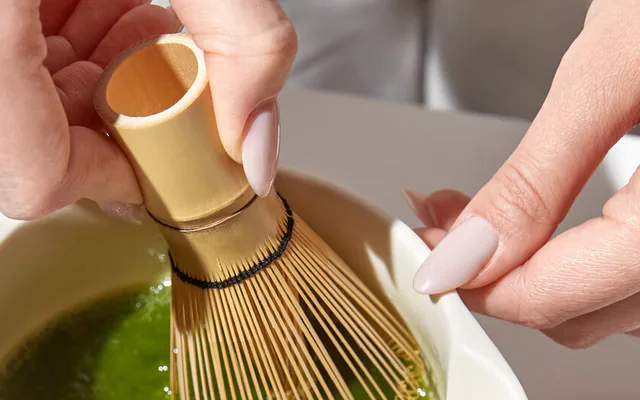
- Whisk for 15–20 seconds with a bamboo chasen in a W motion, an electric frother, or in a sealed jar. The base should be uniform with a fine foam on top.
- Heat the milk to 60–65 °C and froth it. Above 70 °C milk loses its natural sweetness and starts to smell "cooked", which flattens the delicate umami of matcha.
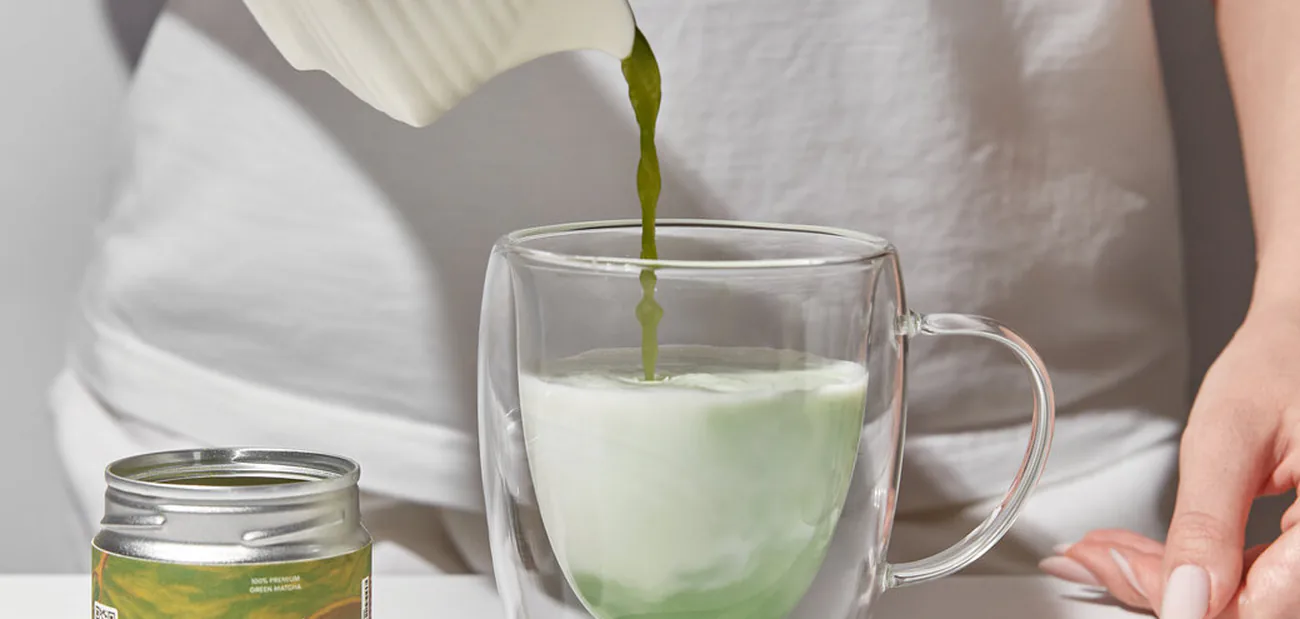
- Pour the milk down the side of the vessel, slowly, onto the finished base. The foam stays on top.
Do not sweeten it straight away. Good ceremonial matcha carries its own natural sweetness from L-theanine — sugar is usually only needed with lower grades, to mask bitterness.
Iced matcha latte
The cold version is easier and far more forgiving — chill mutes any bitterness.
- Sift 2 g of matcha and whisk it with 40 ml of room-temperature or lukewarm water. Cold water disperses the powder poorly, so the base is always made warm.
- Fill the glass with ice — properly full, not half. Too little ice means a watery drink within two minutes.
- Pour in 180–200 ml of cold milk.
- Add the matcha base last — it cascades down through the ice as a green layer. That is the effect everyone photographs.
Stir before drinking. The layers look good in a photo, but the drink only tastes right once combined.
Which milk works best?
- Oat (barista edition) — the café default and, in our view, the best choice. Natural sweetness, creamy body, froths well and does not shout over the matcha.
- Whole dairy (3.2%) — the creamiest, though the fat masks some of the umami detail.
- Almond — light and faintly nutty; can split when heated.
- Soy — froths reliably but has a strong flavour of its own that competes with the tea.
- Coconut — excellent iced, dominant when hot.
Five mistakes that make matcha latte bitter
- Boiling water. The most common error and the easiest to fix. Boil, then let the kettle stand for 3–4 minutes.
- Not sifting. Lumps are not a cosmetic issue — undispersed powder gives bitter pockets.
- Powder straight into milk. Without a water base it will never disperse.
- Too little matcha for the volume. 2 g is right for 200 ml, not for 400 ml.
- Culinary grade instead of ceremonial. Culinary matcha is designed for baking, where sugar and fat hide bitterness. A latte offers nowhere to hide. We cover the difference here: ceremonial vs culinary matcha →
No chasen, no frother — can it still work?
It can, and surprisingly well. A jar with a lid: add the sifted matcha, pour in the water, seal, shake for 20 seconds. You get a dense foam and no bamboo to dry afterwards. It is the method we recommend to anyone starting out — the kit can wait until you know matcha is a daily habit.
If you would rather start with everything at once, the starter set with a chasen has it in one box.
How many calories are in a matcha latte?
Matcha itself is about 3 kcal per serving — all the calories come from the milk and any syrup. An oat-milk latte lands roughly at 90–120 kcal, whole dairy around 130–150 kcal, and matcha on water (usucha) is effectively zero. That is why unsweetened matcha latte often replaces sugary coffee drinks: the calories stay entirely under your control.
How do you make a matcha latte step by step?
Sift 2 g of matcha, whisk it with 50–60 ml of water at 70–80 °C, then pour 150–200 ml of milk heated to 60–65 °C onto the finished base. The order matters — powder tipped straight into milk will not disperse and will clump.
How much matcha goes into one latte?
2 g for a mug up to 200 ml and 3 g for a 300–400 ml mug. With too little powder the drink looks green but tastes like faintly grassy milk.
Which milk is best for matcha?
Barista-edition oat milk — naturally sweet, froths well and does not overpower the tea. Whole dairy milk gives the creamiest result, but the fat masks some of the umami notes.
Why is my matcha latte bitter?
Usually boiling water instead of 70–80 °C, unsifted powder, or culinary grade instead of ceremonial. A latte has no baking sugar or fat to hide a lower grade behind.
Can you make a matcha latte without a frother?
Yes. The simplest method is a jar with a lid: add sifted matcha, pour in water, seal and shake for 20 seconds. It builds a dense foam with no equipment at all.
How many calories are in a matcha latte?
Matcha itself is about 3 kcal. An unsweetened oat-milk latte is roughly 90–120 kcal, and one made with whole dairy milk around 130–150 kcal.