How many grams of matcha per serving — ratios that work every time
The short answer: 2 grams to 60–70 ml of water. But grams alone mean nothing until you know how much water follows them — which is why two people with the same teaspoon end up with two completely different drinks.
“How much matcha per serving” comes up more often than any other question about preparation. The answer is simple, it is just usually given in the wrong unit: not in teaspoons but in grams — and always together with the amount of water.
The short answer — five situations
| Drink | Matcha | Liquid |
|---|---|---|
| Usucha (classic, thin) | 2 g | 60–70 ml water |
| Koicha (thick, ceremonial) | 4 g | 30 ml water |
| Matcha latte | 2–3 g | 30–40 ml water + 150–200 ml milk |
| Iced / bottled | 3 g | 300–400 ml water with ice |
| Baking | 5–10 g | per 100 g of flour |
If you remember one line, make it the first one. Everything else is a variation on the same ratio.
Why a teaspoon is not a gram
Matcha is unusually light and fluffy — the same teaspoon holds anywhere from 1 to 4 grams depending on how you scoop it and whether the powder has just been sifted. That is where contradictory advice online comes from: everyone says “a teaspoon”, but everyone means a different mass.
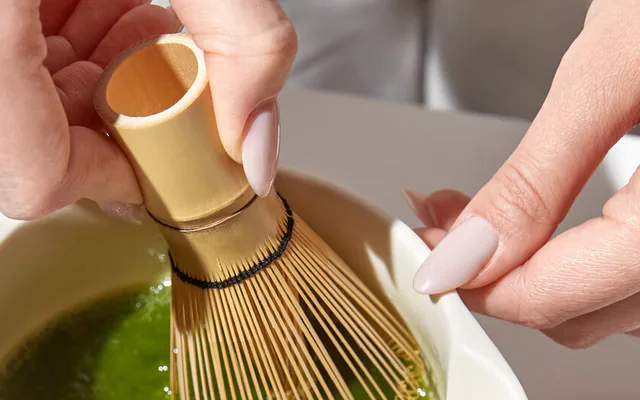
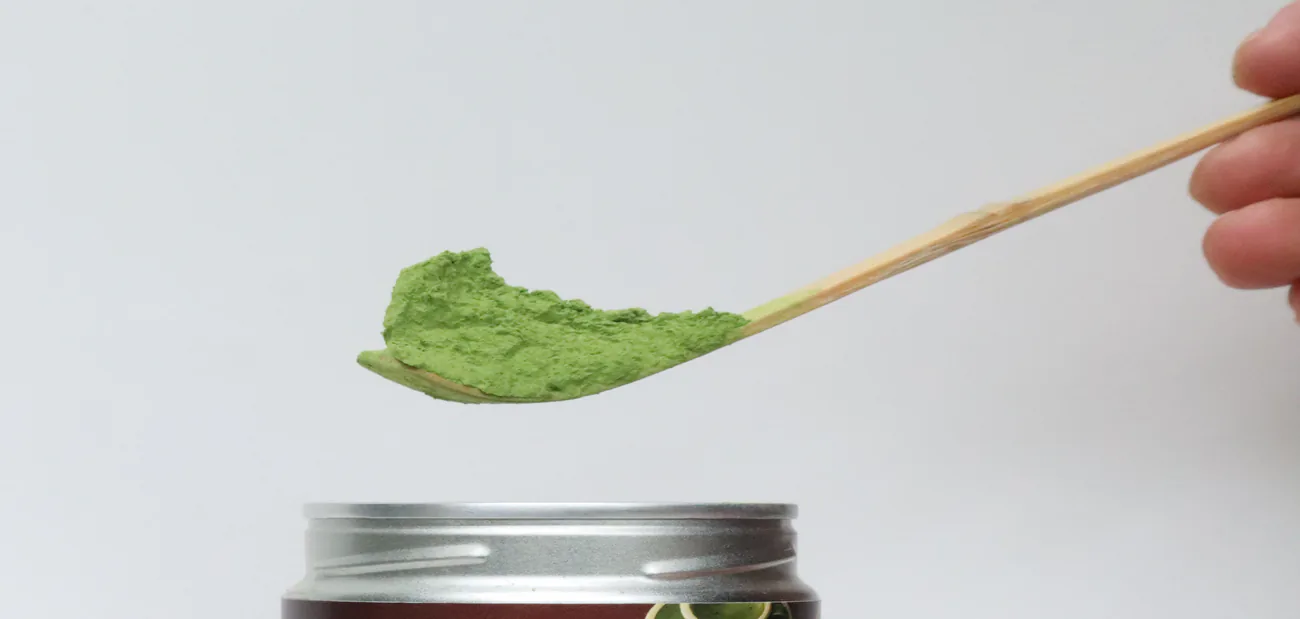
- Chashaku (the bamboo scoop from a set) — one serving is two full scoops, roughly 2 g. It is the only spoon designed for this powder.
- Level teaspoon — around 2 g, but only if you strike off the excess instead of eyeballing it.
- Heaped teaspoon — 3–4 g. This one is behind most complaints that “my matcha is bitter”.
A kitchen scale accurate to 0.1 g costs less than a single tin of good matcha and settles the question for good. Weigh every serving for the first week; after that your hand remembers what two grams look like.
The ratio matters more than the weight
Two grams in 60 ml and two grams in 200 ml are not a stronger and a weaker version of the same drink — they are two different drinks. The first is dense, creamy and holds foam. The second is watered down, and everything bitter in the powder comes forward because there is nothing to balance it.
| Ratio | Result |
|---|---|
| 3–4 g / 100 ml | dense, intense, clear umami — classic usucha |
| 2 g / 100 ml | lighter; a good place to start and to drink through the day |
| 1 g / 100 ml | “green water” — astringency without body |
If the drink tastes weak, take away water before you add powder. Doubling the matcha to chase colour is the most expensive and most bitter way to fix a problem that was caused by too much water.
Matcha latte — why it takes more powder
In a latte, matcha competes with milk: fat and lactose mute both the bitterness and the umami. So 2 g that work beautifully in water become barely noticeable in a glass with milk.
- Sift 2–3 g of matcha into your vessel.
- Disperse it in 30–40 ml of water at 70–80 °C — paste first, then the rest. This step is what keeps it lump-free.
- Top up with 150–200 ml of milk, warmed to 60–65 °C or cold over ice.
With plant milks (oat, almond) go to the upper end of the range — they are sweeter and thicker, so they take up even more of the matcha’s space. Full method with variations: matcha latte step by step →
Iced and bottled
Cold water pulls out less bitterness, so you can be bolder with the powder: 3 g to 300–400 ml makes a good base for the whole day. Disperse the matcha in a splash of water first, or shake it in a sealed bottle for 20–30 seconds — powder takes longer to break up in cold water. Details and a cold-brew version: iced matcha →
For baking
Different logic here: matcha is not the drink, it is a seasoning and a colour. Start at 5–10 g per 100 g of flour — less gives barely a tint, more starts to turn bitter in the batter. Ceremonial grade makes no sense in the oven: its sweetness disappears under sugar and fat anyway. Why matcha cakes turn brown and how to prevent it: matcha for baking.
What comes with the grams
Grams are not only flavour — they are caffeine too. Two grams of matcha carry roughly as much as an espresso (in the order of 60–70 mg). A three-gram serving is closer to 100 mg, and two of those a day approach half the amount EFSA considers safe for adults (400 mg). Nothing alarming, but worth knowing what counts: caffeine in matcha and how much matcha per day.
In a café: weigh it, don’t estimate
For one bowl a day, the difference between 2 and 3 grams is a matter of taste. At a hundred cups a day it is a matter of arithmetic: one gram per serving is kilograms a month in consumption and in menu cost. That is why venues portion by scale or dispenser rather than by spoon — and why the recipe belongs on paper in grams and millilitres, not in “teaspoons”. How that translates into food cost: cost of a matcha latte serving.
Four mistakes that ruin the ratio
- A wet spoon in the tin. Moisture clumps the powder and speeds up ageing — always scoop with something dry.
- Whisking into all the water at once. The chasen has nothing to work against and no foam forms. Paste from a few millilitres first, then the rest.
- Topping up “by eye” after tasting. Matcha added late never disperses properly and leaves lumps.
- The same dose for every grade. Culinary grade at a ceremonial dose is simply bitter — the differences are here.
Where to start
Start at 2 g to 70 ml and change one variable at a time: drink the same thing for three days, then change either the water or the powder — never both. With good ceremonial matcha those 2 g are enough; if you have to keep adding powder to taste anything, the problem is usually the powder, not the dose. Our SABI 30 g and IKI 30 g hold about fifteen servings — a good size for finding where your own ratio sits.
How many teaspoons is 2 grams of matcha?
A level teaspoon is roughly 2 g; a heaped one can be 4 g. Two full bamboo chashaku scoops make the standard 2 g serving. For the first week it is worth weighing the dose on a scale accurate to 0.1 g — after that your hand remembers the volume.
How much matcha for one cup?
The classic serving is 2 g to 60–70 ml of water at 70–80 °C. For a larger cup, do not keep adding powder — hold a ratio of about 3 g per 100 ml, otherwise the drink turns astringent.
How much matcha for a matcha latte?
2–3 g to 30–40 ml of water and 150–200 ml of milk. Milk mutes the flavour, so a latte usually takes half a gram more than the water version; with sweet plant milks, use the top of the range.
Does more matcha mean more flavour?
Up to a point, after which only bitterness and astringency grow. If the drink tastes weak, reduce the water first — add half a gram of powder only if that does not help.
How many servings are in a 30 g tin?
About fifteen servings of 2 g. A 100 g pack gives roughly fifty, and a kilogram around five hundred — that last figure is the basis of every café cost calculation.
Do the same ratios apply to baking?
No. In a batter matcha works as a seasoning and a colour: start at 5–10 g per 100 g of flour, and ceremonial grade has no advantage over culinary there, because its sweetness disappears under sugar and fat.